Major objectives
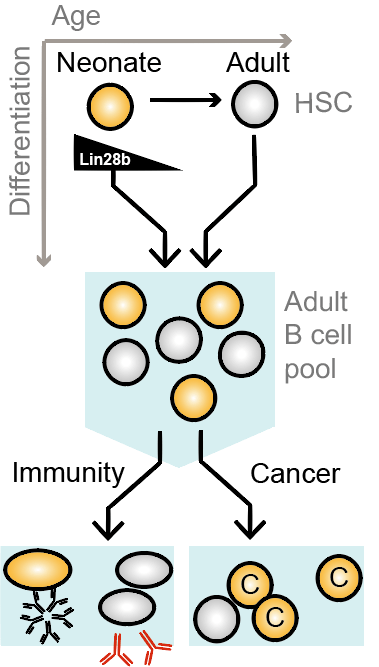
- Peeling back the layers of the adult B cell repertoire to resolve the division of labor among ontogenically distinct B cells in health and disease.
- Interrogating early-life determinants responsible for developmental changes in B cell output.
Our research addresses important gaps in our knowledge of how nature and nurture shape the formation of a complex and balanced immune system with important implications in life-long health and the origin of B cell cancers.
Our lab has previously identified a critical regulator of fetal lymphopoiesis, LIN28B, that endows hematopoietic stem and progenitor cells to regenerate a wider array of B cell subsets compared to their adult counterparts (Yuan et al. Science, 2012, Kristiansen et al. Immunity, 2016). Building on this work, we are currently working to peel back the layers of the adult B cell repertoire to resolve the division of labour among ontogenically distinct B cell subsets in health and disease. We are particularly interested in exploring the unique properties of neonatally induced B cell memory in the context of immune imprinting and long-term immune homeostasis. Furthermore, we seek to understand the molecular and environmental forces that shape early life immune cell output.
To this end, we have developed an extensive genetic toolkit aimed at establishing causality between developmental and immunological events disparate in time. These include 1) lineage tracing models that stratify the adult B cell compartment based on developmental origin 2) models in which critical effector functions are impaired specifically in B cells of neonatal origin 3) models with various perturbations of the fetal RNA-binding protein LIN28B. Our lineage tracing approach excels at establishing causality between developmental and immunological events disparate in time and space and represents a new way of stratifying the adaptive immune system. These in combination with antigen receptor repertoire analyses, immunization strategies, and cancer models provide a unique path to understand how early life derived B cells can be targeted or leveraged for improved vaccination strategies and immunotherapies.
Select publications:
A self-sustaining layer of early-life-origin B cells drives steady-state IgA responses in the adult gut, Immunity, Volume 55, Issue 10, 2022. Stefano Vergani, Konjit Getachew Muleta, Clément Da Silva, Alexander Doyle, Trine Ahn Kristiansen, Selene Sodini, Niklas Krausse, Giorgia Montano, Knut Kotarsky, Joy Nakawesi, Hugo Åkerstrand, Stijn Vanhee, Sneh Lata Gupta, David Bryder, William Winston Agace, Katharina Lahl, Joan Yuan.
Lin28b controls a neonatal to adult switch in B cell positive selection. Sci Immunol. 2019. Vanhee S, Åkerstrand H, Kristiansen TA, Datta S, Montano G, Vergani S, Lang S, Ungerbäck J, Doyle A, Olsson K, Beneventi G, Jensen CT, Bellodi C, Soneji S, Sigvardsson M, Gyllenbäck EJ, Yuan J.
Enhanced protein synthesis is a defining requirement for neonatal B cell development. Front Immunol. 2023. Åkerstrand H, Boldrin E, Montano G, Vanhee S, Olsson K, Krausse N, Vergani S, Cieśla M, Bellodi C, Yuan J.
Developmental cues license megakaryocyte priming in murine hematopoietic stem cells. Blood Adv. 2022. Kristiansen TA, Zhang Q, Vergani S, Boldrin E, Krausse N, André O, Nordenfelt P, Sigvardsson M, Bryder D, Ungerbäck J, Yuan J.
Cellular Barcoding Links B-1a B Cell Potential to a Fetal Hematopoietic Stem Cell State at the Single-Cell Level. Immunity. 2016. Kristiansen TA, Jaensson Gyllenbäck E, Zriwil A, Björklund T, Daniel JA, Sitnicka E, Soneji S, Bryder D, Yuan J.
Lin28b reprograms adult bone marrow hematopoietic progenitors to mediate fetal-like lymphopoiesis. Science. 2012. Yuan J, Nguyen CK, Liu X, Kanellopoulou C, Muljo SA.
Find the rest of our publications on Google scholar.
 The Yuan lab